Joram Piatigorsky

Joram turned to writing following a successful career in science. To his surprise, the two have a lot in common. Joram's latest publication is a collection of short stories, Notes Going Underground. Additional publications include The Open Book and Other Tales of Love and Yearning (short stories), Jellyfish Have Eyes (novel), Gene Sharing and Evolution:
The Diversity of Protein Functions
(non-fiction), and The Speed of Dark, a Memoir (non-fiction).

More Posts from Joram

Dead and Alive

Dead and Alive

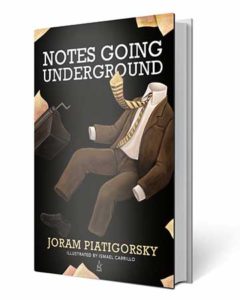
Cover: Notes Going Underground by Joram Piatigorsky. Original illustrations by Ismael Carrillo

Can dead and alive occur simultaneously? The conventional answer based on science would be no, dead and alive are mutually incompatible states. Death wouldn’t exist without life, and life would need redefinition without death. Death is the final and inevitable consequence of life.

However, stories in my upcoming book, Notes Going Underground, explore the porous barrier between life and death…


read more...
Dipping Into History

Dipping Into History

Several weeks ago I went to the Avalon Theater in DC to see three silent movies – classics from an earlier era – accompanied by live music of the earlier times played by The Peacherine Ragtime Society Orchestra. The event recreated an evening in the 1920’s. What an unexpected thrilling evening! We saw Habeus Corpus (1928) starring Stan Laurel and Oliver Hardy, The Adventurer (1917) starring a very young Charlie Chaplin, and One Week (1920), an early masterpiece starring Buster Keaton. … These masters were actors, yes, but also acrobats, and artists, reminding me that the beginning stages of new endeavors are far from being primitive.

read more...
Why Write?

Why Write?

Chapel of Bones in Evora, Portugal (Photo by Joram Piatigorsky)

During a recent talk at the outdoor Lisbon Book Festival, I was asked what drives me to write. While I was satisfied with my answer at the time, I realized I had skirted the question, “Why write?”

The question followed me in as I entered the famous Chapel of Bones in Evora, Portugal. There, a poem on a pillar encourages further reflection.

That last line – “The more you pause, the more you will progress” – makes me wonder whether I write to pause, to reflect and thus progress, whatever that might mean. Do I write to ‘progress’? …

Read More

read more...